
 English
 Pусский


Article Overview: This article explains the fundamental technology behind a paper cup forming machine, its working process, key specifications, and how to evaluate options for your production line. It is intended for engineering managers, technical buyers, and operations leaders conducting early-stage research on automated cup forming equipment.
What Is a Paper Cup Forming Machine?
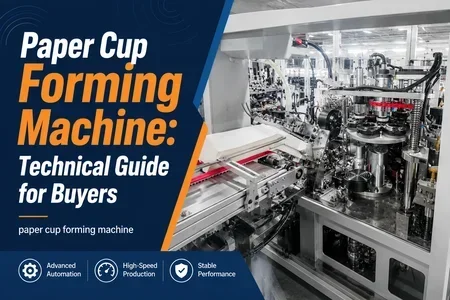
A paper cup forming machine is an industrial assembly system that converts flat, PE-coated paper blanks into finished disposable cups through a sequence of automated mechanical and thermal operations. These machines integrate paper feeding, sidewall forming, bottom sealing, curling, and collection into a continuous production flow. Depending on speed class, output ranges from 80 to over 200 cups per minute.
The machine typically consists of multiple stations arranged on a rotary or linear indexer. Each station performs a specific forming action—heating, pressing, folding, or sealing—controlled by a programmable logic controller (PLC) and servo motors. Modern machines use servo-driven systems for precise timing and reduced mechanical wear.
How Does a Paper Cup Forming Machine Work?
The forming process follows a defined sequence of steps that transform flat blanks into rigid cups. Below is a typical workflow for a medium-speed machine.
Step 1: Paper Blank Feeding
Individual die-cut paper blanks are picked from a stack by vacuum suction cups and transferred onto the machine's indexer. The feeding system must handle single-PE and double-PE coated papers without jamming. Sensors detect misfeeds and trigger alarms.
Step 2: Sidewall Forming and Seaming
The blank is wrapped around a mandrel and the overlapping edge is heated to melt the PE coating, then pressed to form a strong side seam. Ultrasonic welding is an alternative for certain materials, especially in double-wall cup production.
Step 3: Bottom Knockout and Sealing
A pre-cut bottom disc is positioned inside the cup body. A heated punch presses the bottom against the sidewall, bonding the PE layers. The bottom seal must be leak-proof, which is verified by visual inspection or test samples.
Step 4: Rim Curling
The top edge of the cup is curled outward to create a smooth rim. This improves drinking comfort and adds structural rigidity. Curling rollers shape the rim while the cup rotates on the mandrel.
Step 5: Stacking and Collection
Finished cups are discharged onto a conveyor or into a stacking unit. Many machines include automatic counting and batch collection. High-speed systems may integrate with packaging machines for direct pack-off.
Why Does Speed Class Matter for a Paper Cup Forming Machine?
Speed classification directly affects machine construction, cost, and operational complexity. Three broad categories exist:
- Medium-speed machines: Typically 80–130 cups per minute. Suitable for small to mid-volume production. Often use open cam mechanisms and simpler PLC control. Examples include typical medium-speed models.
- High-speed machines: 130–200+ cups per minute. Use servo-driven stations, advanced lubrication, and closed-loop control. Require higher capital investment but lower per-unit cost at scale.
- Specialty machines: For double-wall cups, cups with handles, or paper bowls. Speeds vary but are generally lower (60–100 units/min) due to added processes like ultrasonic handle welding.
When selecting a speed class, consider your daily volume requirement, material compatibility, and operator skill level. A medium-speed machine often offers better flexibility for product changeovers, while high-speed lines are optimized for long runs of standard cup sizes.
How to Choose the Right Paper Cup Forming Machine for Your Production Line?
Procurement decisions involve evaluating multiple technical and business factors. Below is a structured checklist used by engineering teams.
Phase 1: Capacity and Speed Requirements
Define target output per shift. For example, a 100-cup/min machine running 16 hours produces roughly 96,000 cups. Account for setup time, material changes, and maintenance downtime. Factor in future growth.
Phase 2: Material and Cup Specifications
Confirm that the machine handles your paper weight range (typically 170–350 g/m²), PE coating type (single or double side), and cup sizes (e.g., 3 oz to 16 oz for beverage cups, larger for bowls). Check adjustability for diameter and height changes. For medium-speed paper cup forming machines, changeover is often simpler than on high-speed lines.
Phase 3: Automation and Control Features
Review PLC capabilities, touch-screen interfaces, diagnostic alarms, and data logging. Servo-driven machines offer better repeatability and lower noise. Verify that the control system matches your existing maintenance expertise.
Phase 4: After-Sales Support and Spare Parts
Assess the supplier's service network, warranty terms, and spare parts availability. Request documentation for routine maintenance intervals. A reliable supply of wear parts (heating elements, grippers, bearings) minimizes downtime.
What Technical Specifications Should You Inspect Before Purchase?
When reviewing a paper cup forming machine data sheet, pay close attention to these parameters:
- Nominal speed vs. stable speed: The maximum theoretical speed is often higher than the sustainable practical output. Look for the 'stable speed' figure (e.g., 100–110 cups/min for medium-speed models).
- Paper compatibility: List of acceptable paper types (single/double PE, PLA-lined, etc.) and grammage range.
- Cup size range: Minimum and maximum cup diameter and height. Ensure the machine can produce your target sizes without accessory purchases.
- Power consumption: Rated electrical load (kW) for heating, motors, and pneumatics. This affects operational cost and facility requirements.
- Air pressure: Compressed air volume and pressure needed (typically 0.6–0.8 MPa).
Common Applications and Industry Use Cases
Paper cup forming machines are used across multiple sectors of the food service and packaging industry. The following list outlines typical applications:
- Hot beverage cups: Double-wall cups for coffee/tea (12–16 oz) with insulation layer.
- Cold drink cups: Single-wall cups for soda, water, iced coffee (7–12 oz).
- Paper bowls: For soups, salads, and take-out meals (8–32 oz). Specialty bowl machines feature deeper forming dies and larger bottom discs.
- Cups with handles: For large sizes (20 oz+) where heat protection is needed. Integrated handle pasting stations are available.
- Custom branded cups: Machines capable of in-line printing or accepting pre-printed blanks for promotional events.
FAQ
What is the typical lifespan of a paper cup forming machine?
With regular maintenance and replacement of wear parts, a well-built machine can operate over 10 years. Heavy use at top speed may require major overhauls every 5–7 years.
Can a paper cup forming machine handle biodegradable materials like PLA?
Yes, but the machine must be set to lower heating temperatures (PLA melts at lower temperatures than PE). Some models offer dedicated temperature control profiles for bio-based coatings. Verify compatibility with the manufacturer.
What maintenance is required daily?
Daily tasks include cleaning suction cups, checking heating element condition, lubricating moving parts, and verifying sensor alignment. A preventive maintenance schedule based on running hours is recommended.
How long does it take to change cup size on a medium-speed machine?
Changeover time ranges from 30 minutes to 2 hours depending on the machine design and operator experience. Machines with quick-change tooling and digital settings reduce changeover time significantly.
Conclusion
Selecting a paper cup forming machine requires a clear understanding of your production volume, material specifications, and operational capabilities. By evaluating speed classes, technical specifications, and supplier support, buyers can match equipment to their manufacturing goals. This guide provides a starting point for technical evaluation, but always request a hands-on demonstration or line visit before committing to a purchase.