
 English
 Pусский


Article Overview: This article explains the step-by-step process of upgrading paper cup production from semi-automatic single machines to fully integrated, automated lines. It covers key technologies, planning considerations, and implementation best practices for engineering and procurement leaders evaluating automation investments.
Why Automate Your Paper Cup Production?
Automating a paper cup production line addresses several operational challenges that manufacturers face as order volumes grow and quality standards tighten. Semi-automatic machines require manual feeding of blanks, manual removal of finished cups, and frequent operator intervention. This limits throughput, introduces variability in product quality, and increases labor costs. By moving to automated systems, manufacturers can achieve consistent output, reduce scrap, and reallocate skilled workers to higher-value tasks.
For example, a typical semi-automatic paper cup machine may produce 40–60 cups per minute, while an automated medium-speed machine like the YB-S100 can reach a stable speed of 130 cups per minute. This throughput gain, combined with reduced downtime, directly improves overall equipment effectiveness (OEE).
Automation also enables better integration with upstream and downstream processes. An automated forming machine can be linked to automatic feeding, printing, and packaging units, creating a seamless production flow. This is particularly valuable for manufacturers producing large volumes of standard cup sizes or specialized products such as automatic paper bowl machine lines.
How to Plan Your Upgrade Path?
Upgrading from manual or semi-automatic equipment to a fully automated line should follow a structured approach. The first step is to audit your current production bottlenecks: which stage (feeding, forming, sealing, packaging) limits overall output. Next, define your target production speed and quality specifications. Then, evaluate automation modules that can be added incrementally.
A typical upgrade path includes three phases:
- Phase 1: Core machine automation – Replace or retrofit the forming machine with a model that includes automatic blank feeding, servo-driven forming, and automatic counting/stacking. Medium-speed paper cup forming machines often serve as the foundation.
- Phase 2: Downstream integration – Add automatic packaging equipment such as vertical or horizontal packaging machines. For instance, Yongbo vertical packaging machines offer automatic feeding and sealing, while horizontal four-station models use independent servo motors for precise control.
- Phase 3: Full line integration – Connect all machines via a central control system (PLC) with real-time monitoring and fault alarms. This enables a single operator to oversee multiple lines.
Each phase should be justified by a clear ROI calculation. Factors to include: labor savings, material waste reduction, increased output, and lower per-unit cost. For operations that also produce bowls, consider how an automatic paper bowl machine system can share the same automation framework.
Key Automation Technologies Explained
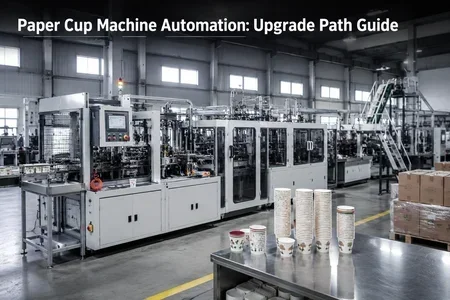
Modern paper cup automation relies on several core technologies:
- Servo-driven motion control: Replaces mechanical cams with digitally controlled servo motors for precise timing and reduced wear. Examples include the independent servo control in four-station horizontal packaging machines.
- Photoelectric detection and fault alarms: Sensors monitor blank feeding, forming quality, and cup ejection. Automatic shutdown on error prevents mass defects.
- Ultrasonic bonding or hot air sealing: For double-wall cups and handles, ultrasonic bonding provides strong, clean seams without glue. The double wall paper cup machine at Yongbo integrates this technology.
- Automatic lubrication systems: Reduces maintenance intervals and extends machine life. Some high-speed bowl machines include self-lubricating features for continuous operation.
When selecting automation components, verify compatibility with your existing line. For example, a high-speed paper cup machine may require upgraded power supply and compressed air capacity.
Implementation Considerations and Common Pitfalls
Automation projects can fail if the organization is not prepared. Key considerations include:
- Operator training: Even fully automated lines require skilled technicians for setup, changeovers, and troubleshooting. Plan for training before installation.
- Spare parts and maintenance: Automated machines with servo drives and PLCs need specialized spare parts. Stock critical components like sensors and servo drives to avoid downtime.
- Material quality: Automated feeding is sensitive to paperboard curl, moisture, and dimensional variation. Work closely with your material supplier to ensure consistent raw material quality.
- Integration with existing equipment: If you already have a double wall paper cup machine or other specialized units, confirm that new automation modules can be synchronized.
A common pitfall is over-automation: investing in full line integration before core processes are stable. Start with reliable core machines, then expand automation step by step.
FAQ
What is the difference between semi-automatic and fully automatic paper cup machines?
Semi-automatic machines require manual feeding of paper blanks and manual removal of finished cups. Fully automatic machines include automatic blank feeding, forming, sealing, counting, and stacking, often with minimal operator intervention.
How much can automation increase my production speed?
Depending on the machine model, automation can increase speed from 40–60 cups per minute (semi-auto) to 100–130 cups per minute (medium-speed fully auto) or higher for high-speed lines. Actual gains depend on your specific setup and product type.
Can I automate my existing paper cup machine?
Some older machines can be retrofitted with servo drives, automatic feeders, and sensors. However, for maximum reliability and speed, replacing the core machine with a modern paper cup machine designed for automation is often more cost-effective.
What certifications should I look for in automated equipment?
While not always mandatory, look for CE certification for export to Europe and local safety standards. Yongbo Machinery’s products are designed with safety interlocks and comply with international norms.
Conclusion
Automating a paper cup production line from semi-automatic to fully integrated is a strategic move that improves throughput, consistency, and cost efficiency. By following a phased approach—core machine upgrade, downstream integration, and full line control—manufacturers can reduce risk and achieve measurable ROI. Careful planning, operator training, and equipment selection are critical to success. For operations expanding into bowl production, automation principles remain consistent. Explore our home page for more resources on paper cup and bowl machinery.