
 English
 Pусский


Article Overview:As global demand for paper cups continues to rise—driven by takeaway food services, vending, and eco-friendly packaging mandates—manufacturers face pressure to increase output without compromising quality. Selecting the right paper cup machine, especially a high-speed model, involves understanding forming speeds, automation integration, and total line efficiency. This guide explains the core concepts, common bottlenecks, and decision factors for technical buyers evaluating high-speed paper cup machines.
What Defines a High-Speed Paper Cup Machine?
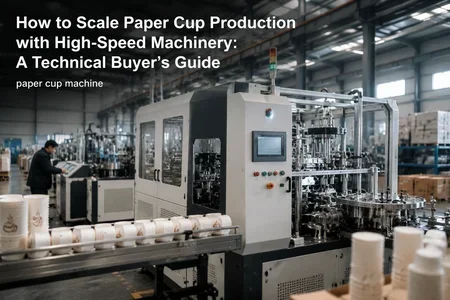
A high-speed paper cup machine is production equipment capable of forming more than 150 cups per minute (cpm) for standard cup sizes (e.g., 6–12 oz). These machines typically employ servo-driven mechanisms for precise control of paper feeding, bottom sealing, curling, and side seaming. In contrast, medium-speed machines operate in the 80–130 cpm range, while low-speed units run below 80 cpm.
Key specifications to evaluate when comparing models include:
- Maximum forming speed (cups per minute) – varies by cup size and material grade.
- Cup size range – ability to switch between small, medium, and large formats.
- Servo motor configuration – full-servo systems offer higher reliability and faster changeovers.
- Material compatibility – support for single-wall, double-wall, and biodegradable substrates.
- Energy consumption – newer designs optimize power use per cup produced.
High-speed machines are often used in centralized production facilities supplying regional distributors or large foodservice chains. For smaller runs, a medium-speed machine may provide better flexibility at lower capital cost. A well-chosen high speed paper cup machine can become the centerpiece of a scalable production line.
Why Production Bottlenecks Occur in Paper Cup Lines
Even with a fast forming machine, overall output can be limited by downstream processes. Common bottlenecks include:
- Packaging speed – manual packing or slow semi-automatic equipment cannot keep pace with forming rates above 100 cpm.
- Material infeed – if paper rolls or pre-cut blanks are not delivered consistently, the machine may starve or jam.
- Size changeovers – adjusting tooling for different cup diameters or heights can take 30–60 minutes, reducing effective runtime.
- Quality inspection – manual checks for leak defects or misformed cups create delays and scrap.
To maximize throughput, manufacturers should consider integrated solutions: a high-speed forming unit paired with an automatic counting and stacking packaging unit. This reduces manual intervention and keeps the line running at capacity. A packing machine synchronized with forming speed can eliminate one of the most common bottlenecks.
What Factors Should You Prioritize When Selecting a High-Speed Machine?
Technical buyers should weigh several factors beyond headline speed:
Drive system: Full-servo machines offer precise motion control, faster size changes, and lower maintenance compared to mechanical cam-driven systems. However, they come at a higher initial investment.
Changeover flexibility: Some high-speed models allow quick tooling swaps (under 15 minutes) using PLC-stored recipes. This is valuable for contract packers who run multiple cup styles daily. For example, a facility producing both 8 oz and 12 oz cups can benefit from a machine that supports rapid size changeovers, reducing downtime.
Material handling: Machines that accept both PE-coated paper and PLA-lined paper enable transition to compostable materials without line replacement. Verify compatibility with your current and future materials.
After-sales support: Verify that the manufacturer provides installation, training, and spare parts availability. Regional service centers reduce downtime.
For instance, if your facility produces mostly 8 oz hot cups for the vending market, a dedicated paper cup machine optimized for that size can achieve consistent outputs with minimal waste. On the other hand, a multi-purpose line might benefit from a medium-speed unit that can switch between single and double wall cups.
How Automation and Ancillary Equipment Improve Overall Efficiency
Automation extends beyond the forming machine. Integrating a packing machine that counts, stacks, and bags cups directly from the forming output eliminates manual labor and reduces handling damage. Similarly, a pasting machine for handle attachment can be synchronized with the forming line.
Evidence from recent installations shows that such integration increases overall equipment effectiveness (OEE) by 15–20% compared to standalone machines. The key is matching speeds: the packaging unit must handle at least the forming rate to avoid queuing. Many high-speed lines today use vertical packaging machines that index cups into rows and pack them into sleeves at speeds above 200 cpm.
For operations leaders, the decision to adopt full line automation depends on labor costs, order volume stability, and target return on investment. A hypothetical scenario: a producer running 10 million cups per year may see payback within 18 months when adding an automatic packing system to an existing high-speed forming line. Additional equipment such as paper bowl machines can diversify production but require separate planning.
Comparison: High-Speed vs. Medium-Speed Paper Cup Machines
To help buyers decide, the table below compares typical parameters for high-speed and medium-speed machines. Note that actual figures vary by manufacturer, cup size, and material—always validate against your specific requirements.
| Parameter | High-Speed Machine | Medium-Speed Machine |
|---|---|---|
| Maximum forming speed | 150–200+ cpm | 80–130 cpm |
| Servo motor configuration | Full-servo (typical) | Partial servo or cam |
| Changeover time | 10–20 minutes | 30–60 minutes |
| Annual output (single shift) | ~15–25 million cups | ~8–12 million cups |
| Floor space required | 30–50 m² (line) | 20–35 m² (line) |
| Investment level | Higher | Moderate |
Choose high-speed when volume and labor cost savings justify the premium; medium-speed fits lower volume or high-mix operations.
FAQ
What is the typical speed of a high-speed paper cup machine?
High-speed paper cup machines generally form 150–200 cups per minute for small to medium sizes. Actual speed depends on cup geometry and paper quality. Some models achieve up to 250 cpm for small sizes.
Can a high-speed paper cup machine handle double-wall cups?
Yes, many high-speed machines can be configured for double-wall forming, though the process may require additional heating or ultrasonic bonding stations. Check the machine's specified cup type compatibility. Dedicated double wall paper cup machines are available for higher reliability.
How much floor space does a high-speed paper cup line require?
A complete line—including forming machine, packing station, and conveyors—typically occupies 30–50 square meters. Exact dimensions vary by configuration and ancillary equipment.
What maintenance is needed for a high-speed paper cup machine?
Routine maintenance includes lubricating moving parts, cleaning sensors, inspecting heaters, and replacing wear items like sealing jaws. Full-servo machines require less mechanical maintenance but need periodic software updates and battery backups for servo drives.
How do I decide between a high-speed and a medium-speed machine?
Consider your annual volume, cup size range, labor costs, and available floor space. High-speed suits large-scale, stable production; medium-speed offers flexibility for shorter runs and faster changeovers. Review medium speed paper cup machines as an alternative if your volumes are moderate.
Conclusion
Scaling paper cup production with high-speed machinery requires a holistic view of forming speed, downstream automation, and changeover efficiency. By understanding the capabilities and limitations of different machine types, technical buyers can select equipment that aligns with their volume targets and product mix. A well-integrated line featuring a high speed paper cup machine solution and automated packaging delivers the throughput needed to compete in today's fast-growing paper cup market. Begin your evaluation by mapping your current bottlenecks, then consult with manufacturers to match speed, flexibility, and service support to your specific production goals.