
 English
 Pусский


Article Overview: This guide provides procurement managers and sourcing teams with a structured approach to evaluating thermoforming equipment suppliers. It covers pre-RFQ preparation, key validation checkpoints, cost-risk tradeoffs, and implementation considerations to help reduce purchasing mistakes and ensure production fit.
Why Is Supplier Evaluation Critical for Thermoforming Equipment?

Thermoforming machines represent a significant capital investment with long-term implications for production efficiency, product quality, and operational costs. A poorly matched machine can lead to downtime, high scrap rates, and unexpected maintenance expenses. For procurement teams, the evaluation process must go beyond price comparisons and basic specifications. Understanding the supplier's manufacturing capability, after-sales support, and equipment reliability is essential to avoid costly post-purchase issues.
Supplier evaluation should include a review of the manufacturer's track record with similar installations, the availability of spare parts, and the responsiveness of technical support. For example, a supplier with a local service network may reduce downtime compared to one that requires international dispatch for repairs. Additionally, evaluate the supplier's willingness to provide performance guarantees and documentation such as CE or UL certification if required for your market.
What Should You Validate Before Issuing an RFQ?

Before sending a request for quotation (RFQ), compile a detailed set of requirements that reflect your actual production needs. This step prevents vague responses and makes supplier comparisons more objective. Key areas to define include:
- Material specifications: Type, thickness, and tolerance of the plastic sheet or film you intend to form. Some machines handle only certain polymers (e.g., PP, PS, PET) or require specific heating profiles.
- Output requirements: Required parts per minute or per hour, including setup and changeover times. Consider future scaling needs.
- Product dimensions: Maximum and minimum formed part size, depth of draw, and wall thickness requirements.
- Energy and utility requirements: Electrical supply (voltage, phase), compressed air, cooling water, and ventilation. Ensure your facility can support the machine.
- Regulatory and compliance needs: Food contact approvals, safety standards, and environmental regulations (e.g., energy efficiency, emissions).
Documenting these parameters clearly in your RFQ helps suppliers provide accurate proposals and reduces the risk of misinterpretation. It also enables you to compare responses on a like-for-like basis.
Key Procurement Checkpoints for Thermoforming Machines
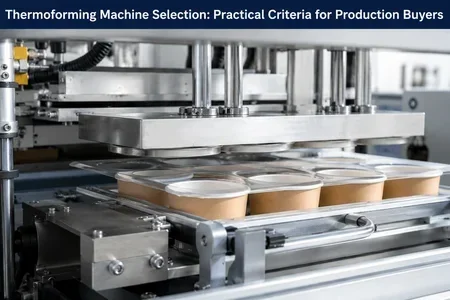
When evaluating supplier proposals, use a structured checklist to assess both technical and commercial aspects. The following procurement checkpoints can help you systematically compare options:
- Machine construction and durability: Inspect frame materials, weld quality, and component brands (e.g., servo motors, PLCs, sensors). Heavy-duty construction often translates to longer service life.
- Heating system efficiency: Evaluate the type of heaters (ceramic, quartz, infrared), zoning control, and energy consumption. Uniform heating reduces scrap.
- Forming and trimming precision: Check for servo-driven movements, registration accuracy, and in-line trimming capabilities. Precision affects part quality and downstream operations.
- Automation and control features: Look for user-friendly interfaces, recipe storage, remote diagnostics, and integration with your existing MES or ERP systems.
- Changeover speed: Fast tooling changes minimize downtime between product runs. Ask about average changeover times for similar tooling.
- After-sales support package: Warranty terms, training provisions, spare parts availability, and technical support response times. Prefer suppliers with local presence or clear service level agreements.
Using a weighted scoring system for these criteria can help prioritize what matters most for your specific application. For example, if you run high-volume single-product lines, changeover speed may be less critical than output consistency.
How to Assess Implementation Risk and Total Cost of Ownership

Beyond the purchase price, consider the total cost of ownership (TCO) over the expected machine life. TCO includes installation, commissioning, energy consumption, maintenance, spare parts, and eventual decommissioning. A lower-priced machine may have higher operating costs due to inefficiency or frequent breakdowns. Request from each supplier:
- Estimated annual energy consumption at typical production rates.
- Recommended spare parts list with costs and lead times.
- Preventive maintenance schedule and associated labor costs.
- Expected lifespan of major components (e.g., heaters, molds, trimming dies).
Implementation risk relates to how easily the machine integrates into your existing production line. Consider floor space, material handling, automation interfaces, and operator training requirements. Schedule a site visit or virtual run-off at the supplier's facility to see the machine operating under realistic conditions. If possible, speak with existing customers about their experience with installation, uptime, and support.
Finally, negotiate a clear commissioning and acceptance protocol. Define key performance indicators (KPIs) such as output rate, scrap percentage, and setup time that must be met before final payment is released. This protects your investment and ensures the supplier is accountable for performance.
FAQ
What is the typical lead time for a custom thermoforming machine?
Lead times vary depending on complexity and customization level. Standard machines may ship in 8–12 weeks, while fully customized lines can take 20 weeks or more. Request a detailed timeline from each supplier during RFQ.
How do I verify a supplier's quality certifications?
Ask for copies of ISO 9001, CE, UL, or other relevant certifications. Check the scope of the certification to ensure it covers the product type. You can also request customer references and audit the supplier's facility if feasible.
Should I buy a new or used thermoforming machine?
New machines offer full warranties, latest technology, and customization. Used machines have lower upfront cost but higher risk of hidden issues and shorter remaining life. For critical production lines, a new machine with service support is generally recommended.
What are common pitfalls in thermoforming machine procurement?
Common mistakes include incomplete specification of materials and output requirements, neglecting utility upgrades, and failing to verify after-sales support. Using a structured procurement checklist reduces these risks.
Conclusion
Selecting the right thermoforming machine requires careful evaluation of technical, commercial, and risk factors. By defining your requirements clearly, using systematic procurement checkpoints, and assessing total cost of ownership, you can make an informed decision that supports production goals and minimizes long-term costs. For a wide range of packaging machinery options, visit the products page to see available configurations. Also review specific machine types such as paper cup machines and high-speed paper cup machines for related forming technologies.
Related site pages: Home, Medium Speed Paper Cup Machine, Double Wall Paper Cup Machine.