


Apr 22, 2026
Author: Site Editor


When buyers search for a Paper Cup Maker, most aren’t just looking for a machine—they want to know: “Which speed suits my monthly orders without wasting capital or creating bottlenecks?” The answer isn’t always “faster is better.” For small to mid-sized workshops producing 200,000–500,000 cups monthly, a medium-speed unit often delivers better ROI, lower maintenance stress, and easier operator training. Yet for high-volume plants with 24/7 shifts and large batch orders, high-speed models (180–210 cups/min) can cut per-unit labor costs by nearly 40% based on 2023 packaging machinery efficiency reports. The real question is not which speed wins—but which one aligns with your current floor space, staff skill level, and order fluctuation pattern.
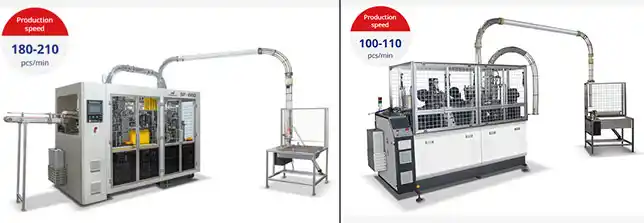
Many buyers fixate on maximum output numbers, overlooking hidden costs like frequent die changes, material alignment errors, or operator fatigue. A machine running too fast for your batch sizes may spend 20% of its time idling or being recalibrated. In contrast, a properly matched unit—whether high or medium speed—improves material yield by up to 5–7% due to fewer startup rejects.
From my experience talking to plant owners in Southeast Asia and South America, the most common regret isn’t buying a slow machine—it’s buying one that doesn’t match their order size variability. If you run 50,000 cups per batch, a medium-speed machine (80–90 cups/min) allows smoother shift changes and easier quality checks. If you run 300,000+ identical cups weekly, high-speed becomes a clear winner.
Even the fastest cup forming equipment becomes a bottleneck if your team lacks experience with high-frequency cam motions and paper feeding tension control. Medium-speed models typically offer more forgiving servo-driven adjustments, reducing waste during shift handovers. A 2022 survey of 150 packaging SMEs found that 68% of unplanned downtime on high-speed lines came from minor operator errors—not mechanical failures.
So before deciding, ask yourself: do you have at least two technicians who understand PLC tuning and lubrication schedules for high-cycle components? If not, a medium-speed solution with simplified controls might keep your daily output more consistent. Many Yongbo clients start with medium-speed units, then add high-speed lines later as their team matures.
[Image: Side-by-side control panels of a standard medium-speed unit and a high-speed model with advanced HMI interface]
High-speed paper cup manufacturing machine models often require reinforced flooring due to vibration at 120+ cycles per minute. They also generate significantly more acoustic noise than medium-speed units—Yongbo's own product literature notes that their servo-driven high-speed machines are designed specifically for "lower operating noise" to reduce environmental pollution, while medium-speed models with open cam and gear transmission systems naturally operate at lower decibel levels. For workshops in mixed-use buildings or with residential neighbors, that difference matters.
Energy consumption is another overlooked factor. According to Yongbo's published specifications, high-speed models like the YB-S180 draw 15 KW while producing 120-150 cups per minute, whereas medium-speed units such as the YB-9 or YB-12 consume only 4 KW for 75-90 cups per minute. That's nearly four times the power draw for roughly double the output. A medium-speed machine running a full shift could cost significantly less monthly than a high-speed unit running partial hours, especially if your local electricity tariff has high demand charges.
Consider these cases where medium-speed cup forming lines outperform faster alternatives:
Custom cup sizes: Frequent changes between 8oz, 12oz, and 16oz with different paper weights. Yongbo's "one-touch mold change" system—featured in their latest servo-driven machines—reportedly cuts mold change time from 2 hours to just 15 minutes. However, for standard medium-speed models with manual adjustments, changeovers typically require more hands-on time, while high-speed units with complex servo synchronization may need longer recalibration between size changes.
Limited batch quantities: Monthly orders below 500,000 cups. Medium-speed avoids the "hurry up and wait" inefficiency.
New operator training: Medium-speed models with open cam and gear transmission (like the YB-12) offer more straightforward tolerance adjustments compared to fully servo-driven high-speed systems.
One bakery chain in Mexico switched from a second-hand high-speed unit to a new medium-speed and reduced their monthly waste from 8% to under 3% within two weeks. The key was matching machine cycle time to their baking sheet change interval—a detail most generic advice ignores.
High-speed machines shine in these conditions:
Single-size mass production for events or supermarket chains
24/5 operation with skilled rotating shifts
Integrated stacking and counting systems that match high output
For example, a disposable cup supplier in Jakarta runs two high-speed units producing 1.2 million 220ml cups weekly for street food vendors. Their cost per thousand cups dropped 28% after switching from medium-speed, purely from labor savings—only possible because they had stable order volume and experienced technicians.
[Image: A high-speed cup machine with automatic counting and stacking conveyor in a well-lit industrial facility]
Most manufacturers sell you whatever they have in stock. That’s where the approach at explore the modular design features differs. Instead of pushing a fixed speed rating, they ask:
What’s your typical batch size range?
Do you run poly-coated paper or biodegradable films (which affect feeding tension)?
How many size changeovers per week?
Is noise reduction a requirement for your neighborhood regulations?
Based on answers, they adjust cam profiles, servo acceleration curves, and even manual crank mechanisms for smaller workshops. This kind of process customization is rare in entry-level machines but makes a real difference in daily operation. One customer in Nigeria runs a medium-speed unit modified for thicker kraft paper—something a standard high-speed machine would struggle with.
Let’s talk numbers. A typical high-speed cup making system may cost 60–80% more upfront than a medium-speed model. But if you run 2 shifts daily, the higher output could recover that difference in 6–8 months through labor and overhead savings. Conversely, if you run single shifts with frequent changeovers, the medium-speed unit often achieves lower cost per good cup because of reduced downtime and rejects.
Include spare parts availability in your calculation. High-speed machines often require precision-ground cams and high-speed bearings with longer lead times. Medium-speed components are more likely to be interchangeable with local industrial suppliers—a critical factor for operations far from major ports.
Don’t let marketing brochures decide. Walk your production floor. Identify your actual bottleneck—is it forming speed, manual packing, material handling, or quality inspection? If forming isn’t the bottleneck, a faster machine won’t help. You’ll just accumulate work-in-progress inventory faster.
For most small to medium businesses starting or upgrading, a medium-speed Paper Cup Maker with room for automation add-ons provides the best balance. For established players with stable large orders and skilled teams, high-speed is a logical step.
Still unsure? Get a tailored recommendation based on your order data directly from engineers who ask the right questions—not just send a price list. Because the right speed isn’t about ego. It’s about matching machine rhythm to your real-world demand rhythm.


 English
 Pусский


