
 English
 Pусский


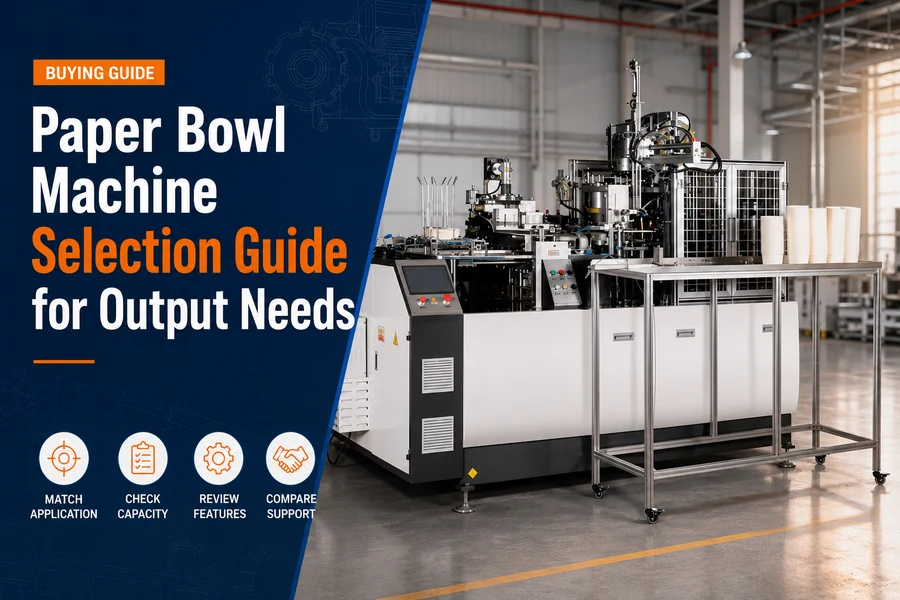
Article Overview: This guide helps procurement managers evaluate paper bowl forming machines for medium-scale production. It answers three critical selection questions covering output speed, disc configuration, and paper specifications, with evidence from technical specifications. The conclusion provides a pre-purchase checklist.
What output speed is suitable for medium-scale paper bowl production?
For medium-scale production, a stable output of 70 to 100 pieces per minute (pcs/min) balances throughput with equipment cost. Speeds above 120 pcs/min suit high-volume operations but require consistent paper supply and higher air pressure.
To determine your target speed, calculate daily production needs and account for machine efficiency. The evidence shows machines such as the YB-WJ70 and YB-WJ150 operate at 65–80 pcs/min, while the YB-WJ200 reaches 120–150 pcs/min. For example, if you need 20,000 bowls per 8-hour shift at 80% uptime (a hypothetical scenario), the required speed is 52 pcs/min. A machine rated at 70 pcs/min provides a buffer for demand spikes.
Step 1: Calculate daily production target
Based on orders or forecasts, determine the number of bowls needed per day.
Step 2: Account for machine uptime
Assume 80% efficiency (including material change and maintenance). Required speed = daily target ÷ (working hours × 60 × 0.8).
Step 3: Select a machine that meets or slightly exceeds that speed
For the example of 20,000 bowls in 8 hours: 20,000 ÷ (8 × 60 × 0.8) = 52 pcs/min. A 70 pcs/min machine provides buffer.
Procurement checkpoint: Verify the machine’s stable speed range, not just maximum speed. Continuous operation at peak speed may increase wear and paper waste.

How do I choose between single disc and multi-disc paper bowl machines?
Single-disc machines typically output 65–80 pcs/min with lower complexity, while multi-disc machines reach 120–150 pcs/min for higher volume. Your choice depends on required output, changeover frequency, and maintenance capacity.
Single-disc designs have fewer moving parts, making maintenance simpler. They are suitable for operations that require frequent size changes because mold swaps are quicker. Multi-disc machines offer higher output per square meter of floor space but require more consistent paper quality to avoid jams. The evidence shows that single-disc models like YB-WJ70 and YB-WJ150 use one forming station, while multi-disc models like YB-WJ200 use multiple stations to achieve higher speeds.
Single Disc
- Speed: 65–80 pcs/min
- Lower initial investment
- Simpler maintenance
- Faster size changeovers
Multi-Disc
- Speed: 120–150 pcs/min
- Higher output per footprint
- More complex maintenance
- Requires stable paper supply
For medium-scale production with varying bowl sizes, a single-disc machine offers flexibility. For dedicated high-volume runs, a multi-disc machine maximizes throughput. Review the machine’s disc design—some multi-disc models allow independent mold adjustments, which can mitigate changeover delays. When evaluating, request data on typical changeover time and waste during start-up.
What paper specifications affect paper bowl machine selection?
Paper bowl machines accept 150–350 GSM PE-coated paper, with top diameters from 75 to 150 mm and heights up to 180 mm. Specifications outside these ranges may cause forming defects or seal failures.
The GSM determines the paper’s stiffness; paper below 150 GSM may tear during forming, while above 350 GSM requires higher forming force. Coating type affects sealing: single PE is standard for cold drinks, double PE provides a moisture barrier. Ensure the machine’s heating and ultrasonic systems are calibrated for your chosen coating. The evidence indicates machines use ultrasonic sealing for the wall and hot air for the bottom sealing.
| Parameter | Typical Range | Impact on Machine |
|---|---|---|
| GSM | 150–350 g/m² | Thinner paper may tear; thicker paper requires more forming force |
| Coating | Single or double PE | Double PE improves moisture resistance but may require higher sealing energy |
| Top Diameter | 75–150 mm | Determines mold size; must be within machine’s adjustable range |
| Height | 45–180 mm | Affects forming stroke; verify mechanical limits |
Before committing to a machine, test your actual paper stock—especially if you plan to use double PE or heavy GSM. Request a sample run to check for curling, seal integrity, and dimensional consistency. Confirm that the machine’s paper path can handle your paper’s surface texture without scratching or misalignment.
FAQ
Can I use a single-disc machine for multiple bowl sizes?
Yes, single-disc machines allow mold exchanges for different sizes. The YB-WJ70 and YB-WJ150 models support top diameters from 75 to 150 mm and heights from 45 to 180 mm. Changeover time varies; request details from the supplier.
What air pressure is required for these machines?
Based on specifications, air pressure ranges from 0.4 to 0.8 MPa depending on the model. For example, YB-WJ70 and YB-WJ150 require 0.6–0.8 MPa, while YB-WJ200 requires 0.6–0.8 MPa. An air compressor is needed.
What power consumption should I expect?
Single-disc machines average 4.8 kW, while double-wall machines may reach 10 kW. Verify electrical infrastructure before installation.
Conclusion: Pre-Purchase Checklist for Paper Bowl Machines
- Define your target output speed based on daily production goals and uptime efficiency.
- Choose disc configuration: single disc for flexibility, multi-disc for volume.
- Verify paper specifications (GSM, coating, dimensions) match machine capabilities.
- Request a sample run with your paper substrate before purchase.
- Review after-sales support, spare parts availability, and technician training.
- Compare total cost of ownership including power, air compression, and maintenance.
For detailed specifications on a high-speed model, refer to the YB-WJ200 paper bowl forming machine specifications. For a full range, see the overview of paper bowl machine models.