
 English
 Pусский


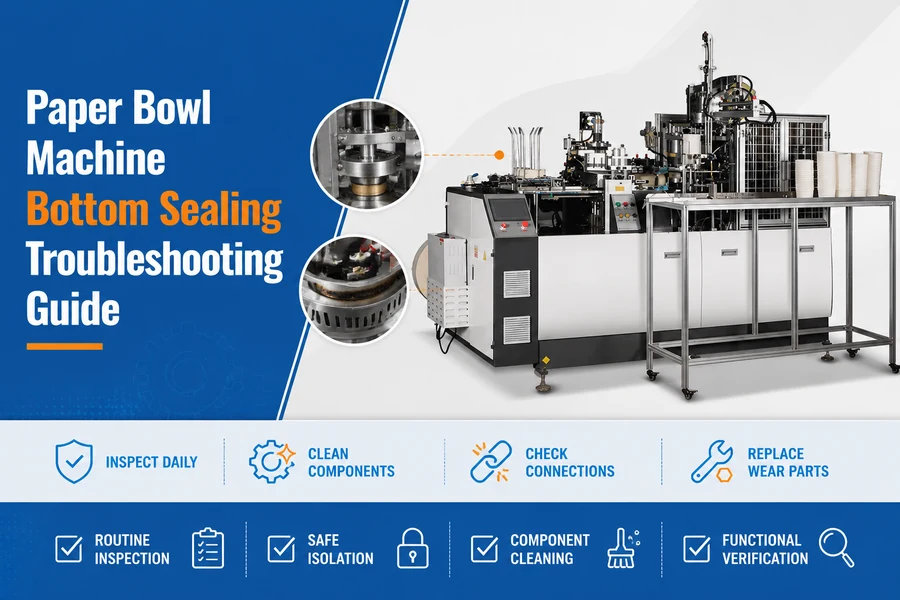
Article Overview: This guide helps CTOs and maintenance engineers diagnose weak bottom seals on automatic paper bowl machines. It covers temperature, paper quality, and pressure causes, with step-by-step adjustment procedures. Evidence is drawn from YB-WJ200 and similar models using hot air bottom sealing.
Why is my paper bowl machine not sealing the bottom properly?
Insufficient heat, incorrect air pressure, or incompatible paper stock are the most common reasons for poor bottom sealing. Check the hot air heating system temperature first, then verify air supply settings; finally inspect paper GSM and PE coating uniformity.
The bottom seal on most automatic paper bowl machines uses a hot air heating system to melt the polyethylene (PE) layer on coated paper. If the temperature is too low, the PE does not bond; if too high, it may burn or degrade the paper. Air pressure also plays a role: the forming die must press the bottom paper against the side wall with consistent force. Additionally, paper specifications outside the recommended range (e.g. GSM below 150 or above 350) can produce weak seals.

What causes bottom seal leaks in paper bowl machines?
Bottom seal leaks typically result from inconsistent heating across the die, insufficient air pressure, or paper with uneven PE coating. The leak often appears as a small gap or weak bond at the bottom edge.
Three primary factors influence leak occurrence:
| Factor | Symptom | Verification Method |
|---|---|---|
| Hot air temperature too low | Bottom paper lifts or detaches after forming | Measure with infrared thermometer at die outlet |
| Air pressure below 0.6 MPa | Bottom seal appears wrinkled or incomplete | Check regulator gauge while machine cycles |
| Paper PE coating weight variation | Intermittent leaks on same paper roll | Measure coating weight with lab equipment (target 8–15 g/m² per side) |
In some cases, the heating element itself may be damaged or the hot air nozzle misaligned. For instance, on the YB-WJ200, the hot air system delivers a stream of heated air directly to the bottom die; if the nozzle is partially blocked, temperature distribution becomes uneven.
How to fix weak bottom seals on paper bowls?
Adjust heating temperature first, then verify air pressure, and finally confirm paper specification. Use the following step-by-step process.
Step 1: Verify and adjust heat
Set the hot air system to the temperature recommended for your paper (e.g., for 250 GSM double PE paper, start at 200°C). Run a test cycle and inspect bottom seal adhesion. If seal is weak, increase in 5°C increments until bond forms. If paper shows scorching, reduce temperature.
Step 2: Check air pressure
Confirm the compressed air line delivers 0.6–0.8 MPa at the machine inlet. Adjust the regulator if below 0.6. Too much pressure (>0.8) may cause paper tearing; too little prevents full compression.
Step 3: Inspect paper stock
Ensure paper GSM is within the machine's specification (150–350 GSM). Verify the PE coating is uniform—visible thin spots (pinholes) or delamination will cause leaks. Replace with paper from a reliable supplier if needed.
Step 4: Clean and align the heating nozzle
Powder or paper dust can block the hot air nozzle. Turn off and cool down the machine, then remove the nozzle and clean with a soft brush. Reinstall and ensure it points directly at the bottom die center.
After each adjustment, run 10–20 test bowls and inspect for consistency. If weak seals persist, consult the machine's maintenance manual or contact the manufacturer.
FAQ
How often should I check the hot air heating element?
Inspect the heating element weekly if the machine runs 8+ hours daily. Look for discoloration or warping. Replace if temperature fluctuates more than ±5°C from setpoint.
Can I use non-standard paper for bottom sealing?
Paper outside 150–350 GSM or without proper PE coating may not bond. Some machines can adjust heating time, but leak risk increases. Always test a sample run of 50 bowls before production.
What is the typical service life of a hot air nozzle?
With regular cleaning, a stainless steel nozzle lasts 6–12 months in continuous production. Replace if you see cracks or distortion that affect airflow direction.
Conclusion: Systematic diagnosis resolves most bottom sealing issues
Weak bottom seals on paper bowl machines are usually solved by methodically checking temperature, air pressure, and paper quality. The hot air system is the core of the bottom seal process; maintaining it at the correct setpoint and ensuring clean, aligned components eliminates most leaks. When selecting a machine, consider models like the YB-WJ200 paper bowl machine with hot air bottom sealing, which includes sensor monitoring for consistent temperature and pressure control. Regular preventive checks as outlined here will keep production running with minimal downtime.